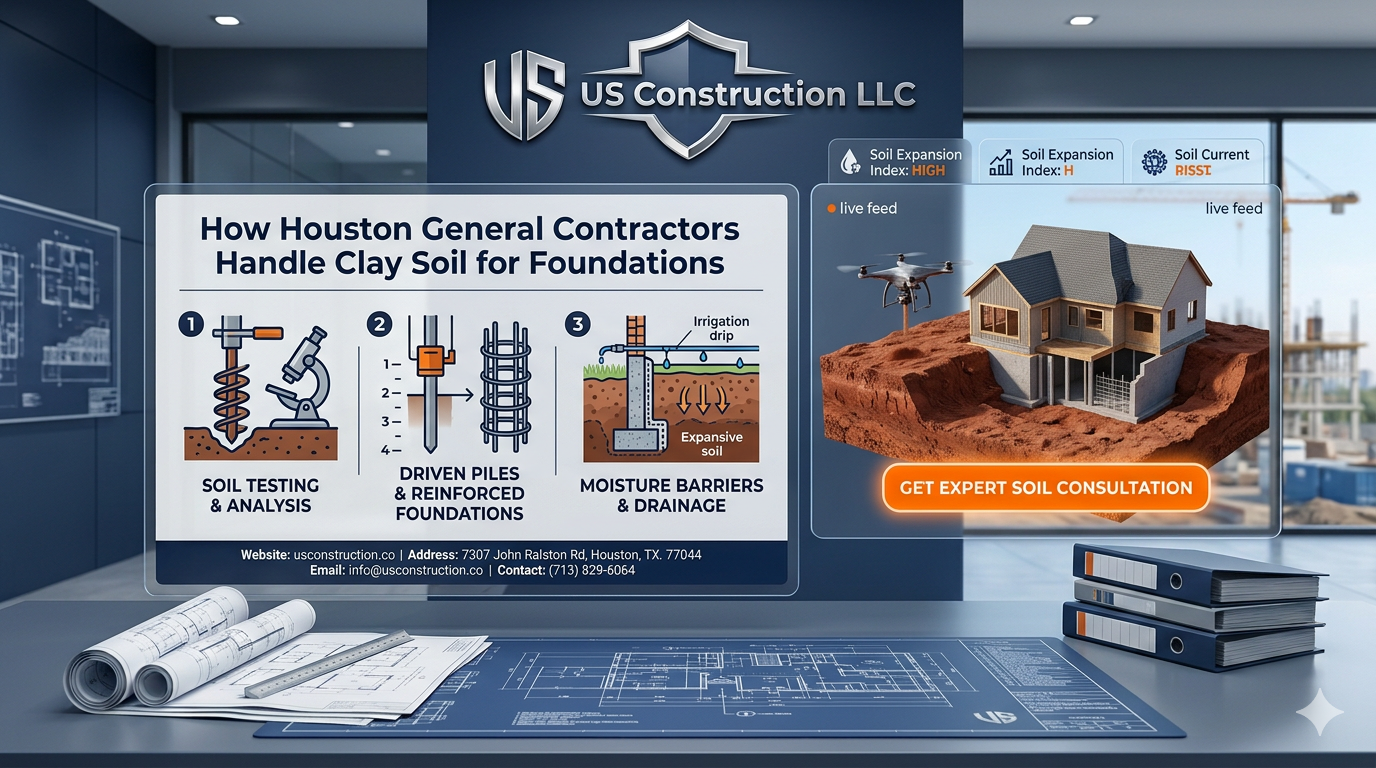
In construction, the foundation performance depends on the geotechnical conditions of the job site. The architectural elements come later to deal with plastic and moisture-sensitive subgrades. For more details, explore how Houston general contractors handle clay soil for the foundation.
Clay soil experiences volumetric expansion and contraction in response to seasonal wet-dry cycles, posing a risk to structural integrity. US Construction LLC adopts innovative solutions like soil stabilization, moisture binding, deep excavation, and compliance with geotechnical reports. Experts integrate various design elements into foundational development to mitigate cracking and settlement concerns.
Challenges of Clay Soil for Foundation Development
Clay-heavy subgrades, especially expansive clays, present major mechanical and engineering obstacles for foundation construction. The volume of these soils varies significantly with moisture content due to their strong plasticity and shrink-swell characteristics. A detailed explanation of the main issues clay soil causes for foundations is mentioned below:
Shrink–Swell (Expansive Soil Movement)
Technical Problem: Clay soils absorb water during rainy seasons, but they compact and lose water content during dry spells. Effect on Foundations:
- Differential settlement
- Cracking slabs
- The displacement of piers
- Cracks in the interior drywall and frame
- Window and door misalignment
Structural stresses can result from unequal shifting or settlement caused by even slight moisture fluctuations surrounding a building.
Differential Settlement
In contrast to coarse soils like sand or gravel, clay does not solidify consistently. The reasons are the uneven moisture distribution and inadequate compaction during site preparation.
Moisture extraction from tree roots and poor drainage exacerbate the conditions. As a result, torsional pressure and permanent cracking are caused by the foundation’s sections moving at varying rates.
Low Bearing Capacity (When Saturated)
When clay becomes excessively wet, its shear strength and load-bearing capacity decline. It creates a great challenge for a general contracting company in Houston, Texas. The soil becomes unstable and malleable. If not adequately engineered, this issue may jeopardize shallow foundations like slab-on-grade systems.
Poor Drainage and Water Retention
Clay possesses minimal permeability and a high capacity to retain water. This results in:
- Water that is standing near foundations
- The accumulation of hydrostatic pressure
- A higher chance of moisture penetration in crawl spaces or basements
- Extended cycles of saturation
This problem is greatly exacerbated by improper grading.
Seasonal Moisture Variability
The movement of clay soil becomes repetitive in regions with consecutive wet and dry periods. Contractors use engineering repercussions for constant cycles of expansion and contraction.
However, concrete fatigue stress and rising maintenance expenses. In addition to initial settling, foundations must be built to withstand long-term soil movement.
Compaction Challenges During Construction
It is challenging to compact clay evenly because it has inconsistent water retention. If it becomes too moist, it becomes unsteady. If it gets too dry, it becomes stiff and challenging to deal with. When site preparation is done incorrectly, moisture conditioning results in:
- The spaces underneath slabs
- Settlement following construction
- A decrease in the structural performance
Tree Root Interaction
Large trees near foundations cause localized shrinkage by drawing moisture from the clay soil. Impact:
- One side of the structure has uneven settling.
- A progressive tilt of the foundation
- Prolonged structural deformation
In housing projects, unbalanced foundation damage is frequently caused by this.
Long-Term Structural Stress
After construction, clay soil continues to move. Repetitive motion over time leads to fatigue fractures in concrete and the rotation of piers. Sometimes, beam deflection, stress, and rupture in utility lines. This raises the expense of lifecycle maintenance.
How Houston General Contractors Manage Clay Soil
Expansive clay is not “fought” by general contractors; instead, it is managed through rigorous construction controls, engineering design coordination, and geotechnical planning. The following methodical techniques are used by seasoned general contractors in Houston, where high-plasticity clay is prevalent:
Geotechnical Investigation First (No Assumptions)
Before making any decisions, conduct a geotechnical investigation. The developer needs background studies of the:
- Lab testing and soil borings
- Analysis of the plasticity index (PI)
- Evaluation of moisture content
- Testing for bearing capacity
The geotechnical report determines the type of foundation, depth, and soil conditioning procedure. Ignoring this step exposes you to serious risk.
Soil Stabilization (Subgrade Modification)
Contractors enhance native clay capabilities to uphold heavy loads of construction by:
Treatment with Lime
- Clay is combined with lime to lessen its flexibility.
- Enhances workability and the ability to support loads.
- The shrink-swell potential is decreased.
Stabilization of Cement
- The strength of compression is increased.
- Makes the substrate more consistent.
- In residential and light commercial developments, this is typical.
Moisture Conditioning and Compaction
It is necessary to compact clay at the ideal moisture content. Houston General contractors pre-wet extremely dry soil, aerate excessively wet soil, and condense in controlled elevators. Conduct density testing, often known as Proctor tests. Post-construction settling is caused by improper compaction.
Engineered Foundation Selection
Contractors work with structural engineers to choose suitable systems based on soil data:
Slab-on-Grade Post-Tension
- Supported by steel wires under tension
- Equitable load distribution
- Prevents cracking due to shifting soil.
Beam and Pier Foundations
- Shifts the burden into more stable layers.
- Diminishes the effect of clay surface expansion
Concrete Piles or Drilled Piers
- Applied to more substantial commercial buildings
- Completely avoid the active clay zone
Foundation selection is based on performance rather than price.
Deep Foundations to Bypass Active Soil Zone
Usually, expansive clay movement takes place in the top 8 to 12 feet of soil. Contractors use drilled shafts as helical piers. Below the active moisture zone, these methods set safe boundaries to stable load-transporting strata.
Drainage Engineering and Moisture Control
Due to the moisture-driven nature of clay movement, contractors actively control water. Appropriate site grading, with a minimum slope of 5% away from the foundation. Perimeter drains or French drains for gutters and down spouts.
Surface runoff control and swales, placing irrigation systems correctly. The structure’s surrounding moisture must be consistent.
Structural Reinforcement Enhancements
Contractors can include:
- The thickness of the slab increased
- Beams of grade
- Beams with reinforced edges
- More steel reinforcing
These reduce cracking and more efficiently disperse stress.
Houston General Contractor Near Me
It takes accuracy, engineering knowledge, and the right construction partner to build on Houston’s vast clay deposits. Skilled general contractors reduce soil movement before it leads to structural failure.
Choose a team knowledgeable about soil dynamics in the area and capable of providing foundations that are stable over the long term. To arrange a consultation and ensure the solid foundation of your project, call US Construction LLC at (713) 829-6064 or visit www.usconstruction.co.